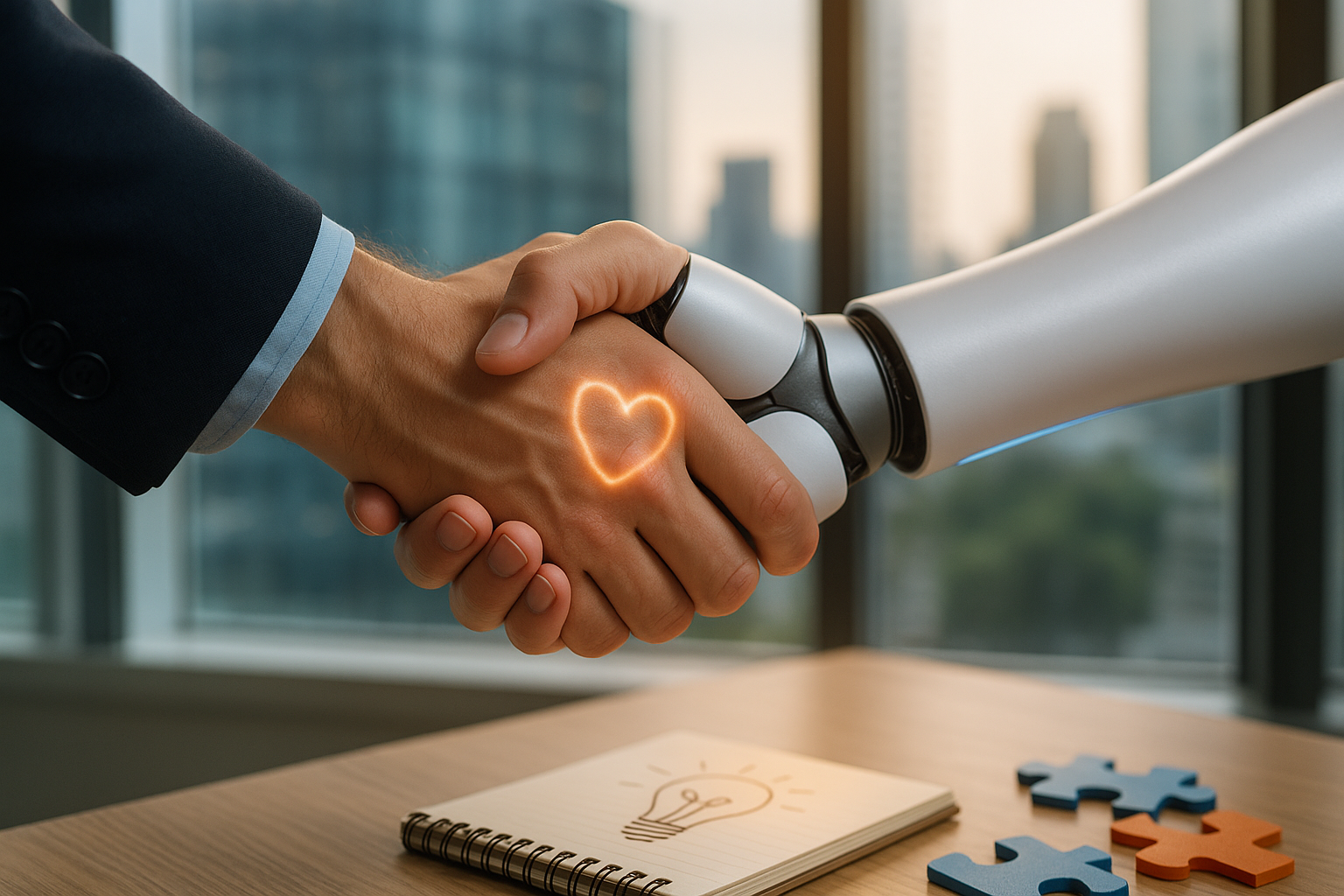
Skills You'll Actually Need for Jobs in 2030 (And How to Build Them in a world of AI)

You Don't Need to Be Smarter Than the Machines. You Need to Be Wiser.
An honest look at the skills that will actually matter in a 2030 job market.
The skills you need aren't the ones anyone is shouting about.
If you are entering college in the year 2026, the job you're preparing for probably doesn't exist yet. Not in the form it will take by the time you're looking for work. The tools will be different, the workflows will be unrecognizable, and the thing employers will be competing to hire won't be someone who can produce more output faster. They'll have AI for that.
What they'll want is someone who can think clearly, decide wisely, and handle situations that don't have an obvious right answer. Which is, if you squint at it, a pretty good description of everything a liberal arts education has always tried to build.
That's not an argument for ignoring technology. It's an argument for understanding what technology can't do.
How most all jobs will be affected by AI
Think about what AI is actually good at. It can draft the email. It can summarize the meeting. It can generate ten different versions of a marketing plan, build the first draft of code, and organize six months of research into a tidy document. It's genuinely impressive, and it's only getting better.
But here's the catch: once you have ten marketing plans drafted in thirty seconds, someone still has to decide which one is right. Someone has to know whether "right" means bold or safe, expensive or lean, this quarter or next year. Someone has to read the room. Someone has to take responsibility for the choice.
That's you. That's the job. And it requires something more than knowing how to use the tools.
Dr. Guy Diedrich, who leads innovation at Cisco, framed it simply: in a world where "can we?" is almost always yes, the more important question is "should we?" And that question doesn't live in software. It lives in philosophy, ethics, psychology, and the kind of critical thinking that lets you hold a complicated situation without rushing to a simple answer.
Five Skills Worth Building Right Now to prepare for a future of AI
The World Economic Forum surveyed over 1,000 major employers about what they expect to need by 2030. The finding that stood out: 39 percent of workers' core skills are expected to change. Not tweak. Change. The skills that ranked highest were less about knowing more and more about thinking better. Here's what that looks like in practice.
1. Analytical thinking
This topped the list, and it's easy to understand why. AI can sound impressively confident while being completely wrong. It will give you a beautifully structured answer about a topic it has subtly misunderstood. Someone has to catch that. Someone has to look at any output, whether it comes from a machine or a person, and ask: does this actually hold up?
Analytical thinking is the ability to separate signal from noise, to distinguish a real pattern from a convenient one, and to make a call based on evidence rather than what feels true. That skill is not taught by any app. It's built slowly, through practice, argument, and the habit of being willing to be wrong.
2. Creative thinking
Not the artsy version, though that counts too. The kind of creative thinking that matters most in a professional context is the ability to reframe a problem. When the obvious approach stops working, creative thinkers ask whether they might be solving the wrong problem entirely. They see constraints as starting points rather than dead ends.
AI generates ideas readily. What it can't do is judge which ideas actually fit the moment, or which ones will move people. That judgment is a human skill, and it gets sharper the more you've read, lived, listened, and disagreed with people who see the world differently than you do.
3. Resilience and adaptability
The tools you learn in college will be outdated before your student loans are paid off. Not useless, just outdated. The ability to adapt, to pick up a new workflow without panicking, to say "okay, new situation, what do I know that still applies?" is one of the most underrated professional skills there is.
Resilience isn't cheerfulness under pressure. It's the quieter ability to stay functional when things are uncertain. Most of adult professional life is uncertain. The people who handle it well have usually been tested earlier and paid attention to what they learned.
4. Leadership and the ability to bring people with you
AI will become a full member of most professional teams within your career. You will be managing workflows that involve both humans and machines. The human part will still be the hard part.
Leadership in this context means being able to set clear goals, create trust, make decisions with accountability, and handle conflict when the stakes are real and the answer isn't obvious. Machines don't do nuance. They don't read a room. They don't know when to say nothing and let someone think. You do. Or you can learn to.
5. Ethical judgment
This is the one most people skip because it sounds abstract, until the moment it isn't. Every organization will face new ethical questions over the next decade: privacy, bias, manipulation, consent, fairness, surveillance. Not hypothetical ones. Real ones, with real consequences.
Ethical judgment isn't about having the right opinions. It's about being able to think clearly when values collide, when what's efficient conflicts with what's fair, when what benefits the company conflicts with what's right for the customer. This kind of thinking is exactly what philosophy, history, and literature train you for, which is one reason those subjects are quietly more valuable than their reputation suggests.
What to Study in college in 2027 to be prepared for a future of AI
Nobody is saying you should major in philosophy and expect a tech company to hand you a job based on your thesis about Kierkegaard. But the either/or framing of "humanities vs. tech" is a false choice, and the people who act like it isn't are usually trying to sell you a bootcamp.
Think of it this way: great cooking requires good equipment and good taste. AI gives you increasingly good equipment. Your education is supposed to give you taste. Taste means knowing what matters, what's worth making, and whether what you produced is any good. No tool teaches you that.
A practically useful education for 2030 would include a few distinct things. First, something from the humanities that builds judgment: ethics, philosophy, literature, history, rhetoric. Not because Shakespeare is a job skill, but because Shakespeare builds the capacity to understand human motivation, fear, ego, loyalty, and the stories people live inside without realizing it.
Second, some grounding in social science: psychology, sociology, organizational behavior. How people actually work, not how they say they work. Third, enough data literacy to reason from evidence, which means basic statistics and the ability to recognize a misleading chart. And fourth, AI literacy, which isn't the same as knowing how to code. It means understanding what AI is genuinely good at, where it breaks down, and how to work alongside it without ceding all judgment to it.
Then, pick a domain. Healthcare, education, real estate, finance, media, law, climate. Wisdom needs somewhere to land. Without a specific field, all of this stays theoretical. With a field, it becomes genuinely useful.
Three Questions to ask yourself when judging AI output
Whenever you use AI for something, or really whenever you're making any significant decision, try running three questions in the background. What is this optimizing for? Who benefits, and who pays? And what would make this a bad idea in a slightly different situation?
That last question is the hardest and the most useful. Any plan can look sensible in the right light. The ability to imagine the light changing is what separates people who think carefully from people who just think quickly.
These are muscles, and muscles grow with use. Four years of college is a long time to build them, if you decide that's what you're doing.
What is Humans role in a world of AI
AI is going to keep getting better at producing. That's settled. The open question is what humans will be for, and the answer is starting to come into focus: humans will be for deciding, judging, leading, and making meaning out of situations that don't have obvious answers.
The job market of 2030 won't be looking for the person who can generate the most output. It will be looking for the person who knows what to do with it.
That person is built in college. Just not the way most people think.